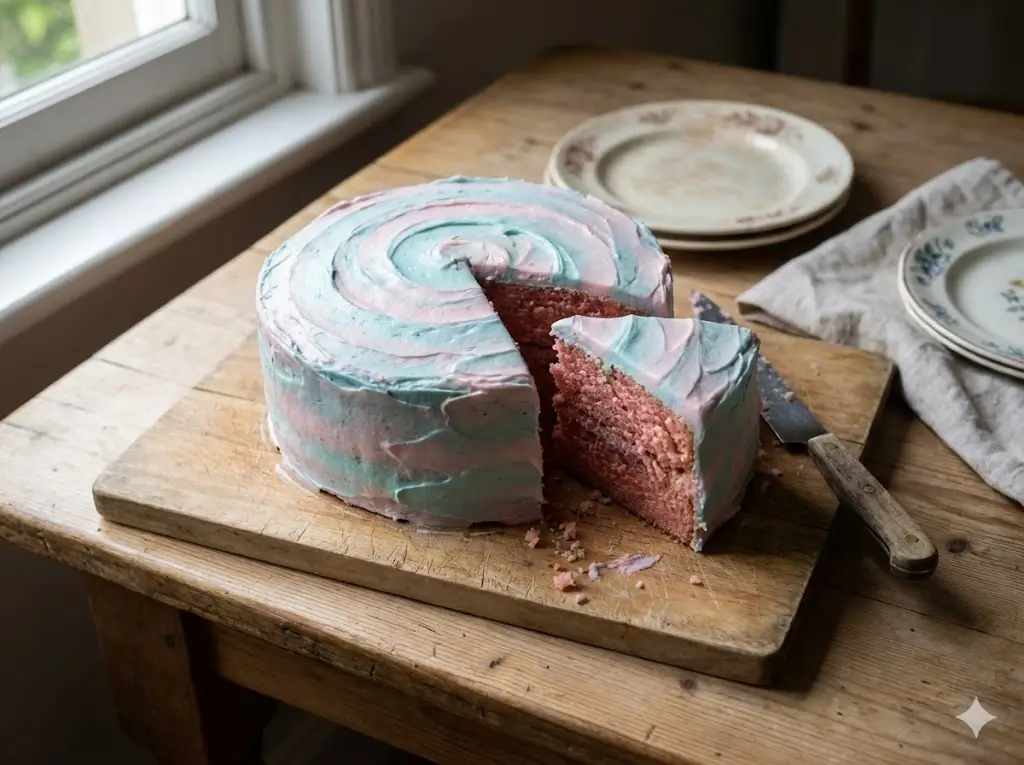
Step 1: The Mise en Place of Mystery
Preheat your oven to $325^{circ}F$ ($163^{circ}C$). Why lower than usual? A slower bake prevents the "dome" effect, giving you a flat surface that is easier to stack. Organize your colored gels (Sky Blue or Rose Pink) in advance. If you are doing a "Piñata" style, have your sprinkles or chocolate candies ready at room temperature.Step 2: The High-Ratio Creaming Method
Cream your butter and sugar for 6 minutes. You want the mixture to look like whipped cream. This provides the structural "scaffolding" to hold the weight of any hidden candy. Gradually fold in your egg whites to maintain aeration.Step 3: The Secret Core Construction
Once the cakes are baked and cooled, use a circular pastry cutter to remove the center of two middle layers. Pro Tip: Save the "plugs" you cut out! You will use a thin slice of one to "cap" the hole after you fill it with your surprise.Step 4: Internal Color Calibration
If you are coloring the sponge rather than using a candy fill, use gel paste only. Liquid dyes can change the pH of the batter, causing the blue to turn green or the pink to turn purple during the Maillard reaction (the browning process).Step 5: The "No-Peek" Crumb Coat
Apply a thin layer of buttercream over the entire cake. This is your "security layer." It traps crumbs and ensures that not a single speck of colored sponge or candy is visible from the outside. Chill for 20 minutes until firm.Step 6: The Final Camouflage
Apply your final layer of frosting. Use a neutral color like white, cream, or a "He or She?" bicolored ombre. Use a metal bench scraper for a smooth finish that looks professional and hides the internal seams perfectly.Step 7: The Temperature Stabilization
Store the cake at a cool room temperature ($68^{circ}F$) for at least two hours before the reveal. If the cake is too cold, the "Piñata" center won't spill out; if it’s too warm, the frosting might slip.