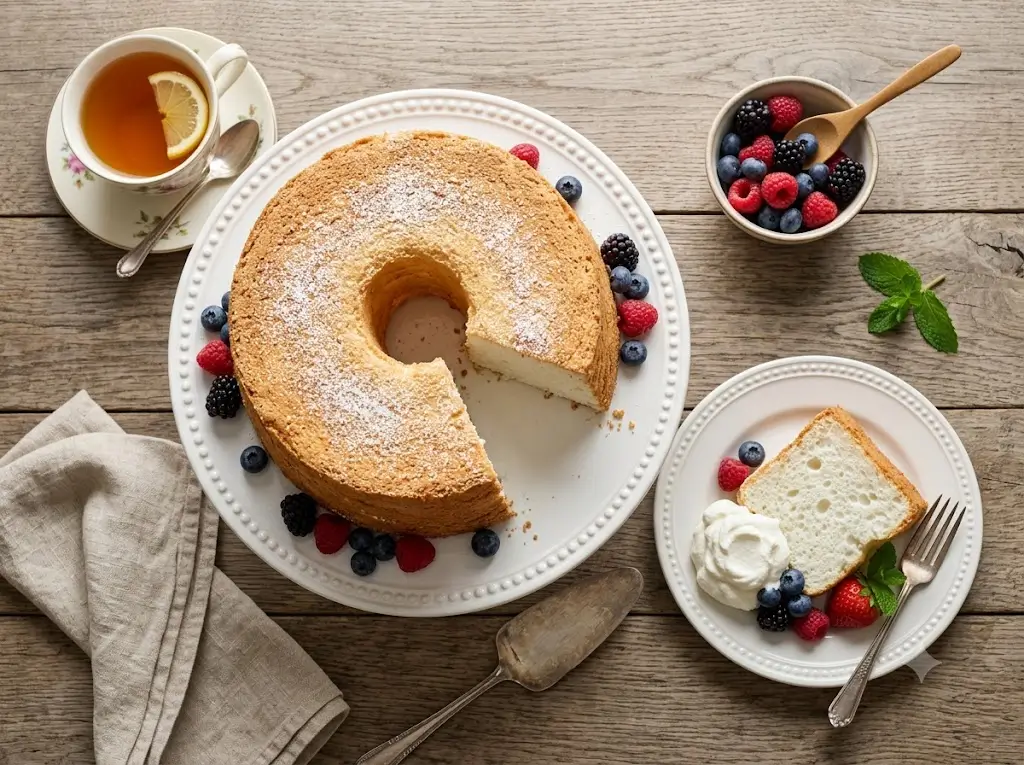
Ingredients
Equipment
Method
Step 1: The Triple-Sift Protocol
Measure your cake flour and half of your powdered sweetener (5/8 cup) into your fine mesh sifter. Sift them together onto a large sheet of parchment paper. Pour the sifted mixture back into the sifter and sift again. Repeat this for a total of three full passes.Actionable Tip: Do not skip this. Triple-sifting separates individual starch molecules and introduces atmospheric air, ensuring the heavy dry ingredients don't crush your delicate egg white bubbles during the folding phase.Step 2: Establish the Acidic Foam
Pour your room-temperature fresh egg whites, sea salt, and cream of tartar into your pristine, bone-dry stainless steel mixing bowl. Begin whipping on medium-low speed (Level 3 or 4 on a KitchenAid) for roughly 2 minutes until the whites transform into a foamy, opaque white liquid that resembles sea froth.Actionable Tip: Cold egg whites separate easily from the yolk, but warm egg whites whip to a significantly higher volume. Separate your eggs straight out of the fridge, then let the whites sit on the counter for 30 minutes before whipping.Step 3: Rain the Sweetener
Increase your mixer speed to medium-high (Level 6 or 7). With the machine running continuously, begin adding the remaining half of your dry powdered sweetener, one tablespoon at a time, allowing each addition to dissolve for 10 seconds before adding the next. Once all sugar substitute is incorporated, pour in the vanilla and almond extracts. Whip until firm, glossy, but slightly drooping peaks form (just shy of stiff peaks).Actionable Tip: Dumping all the sweetener in at once weighs down the unbonded protein network, resulting in a low-volume, chewy meringue. Patience during this 4-minute window dictates the final height of your cake.Step 4: The Three-Stage Atmospheric Fold
Remove the bowl from the mixer. Sprinkle roughly one-third of your triple-sifted flour mixture evenly over the top of the meringue. Take your wide spatula, cut straight down the center of the bowl to the bottom, sweep across the base, and lift the bottom batter up and over the top while simultaneously rotating the bowl a quarter turn. Repeat this gentle folding motion until the flour disappears. Add the second third, fold, then add the final third.Actionable Tip: Never stir or whisk at this stage. Think of your spatula as an elevator gently lifting the batter rather than a spoon stirring soup. If you work too fast, you will knock out the trapped carbon dioxide and oxygen.Step 5: Pan Loading and Air-Bubble Elimination
Gently spoon the airy batter into your ungreased tube pan. Take a thin metal butter knife and run it through the batter in a continuous concentric circle midway between the inner tube and outer wall.Actionable Tip: This slicing motion breaks up massive, unwanted air pockets that would otherwise turn into giant hollow tunnels inside your baked cake.Step 6: The Low-Heat Bake
Place the pan on the lower-middle oven rack and bake at 325°F (163°C) for 38 to 42 minutes. The cake is finished when the top is a deep golden brown, deep cracks on the surface appear dry, and the crumb springs back instantly when gently pressed with a clean finger.Step 7: The Gravity-Defying Cool
The absolute second you pull the cake from the oven, immediately invert the pan upside down. If your pan has little metal standing feet, rest it on those; if not, slide the center tube over the neck of a heavy glass wine or soda bottle. Let it hang suspended upside down at room temperature for a strict minimum of 60 minutes.Actionable Tip: Because angel food cake lacks a rigid internal fat-and-flour structure, cooling right-side up causes the hot, moist starch cell walls to collapse under their own weight, resulting in a dense, rubbery bottom layer.