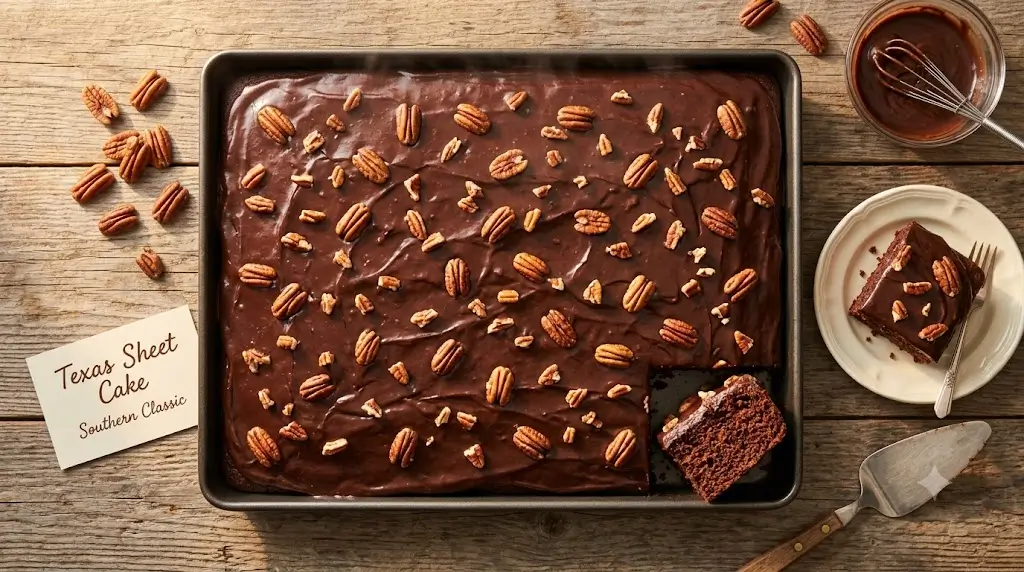
Ingredients
Equipment
Method
Step-by-Step Instructions
Step 1: Prep the Jelly Roll Pan and Preheat
Step 2: Combine the Dry Base
Step 3: Bloom the Cocoa on the Stovetop
Step 4: Merge the Hot Base with the Dry Flour
Step 5: Temper and Whisk the Buttermilk Binder
Step 6: Bake to Springy Perfection
Step 7: Craft the Boiled Glaze (The 15-Minute Mark)
Step 8: The Hot Pour (The Magic Step)
Position an oven rack in the exact center of your oven and preheat to 350°F (175°C). Take a tablespoon of softened butter or a high-quality baking spray and generously grease the entire interior floor and walls of your 18x13-inch half-sheet pan. Unlike standard cakes, we do not line this pan with parchment paper; you will be slicing and serving straight from the metal tin.In your largest mixing bowl, whisk together the 2 cups of all-purpose flour, 2 cups of sugar, 1 teaspoon of baking soda, and ½ teaspoon of fine sea salt. Whisk for a full 30 seconds to ensure the baking soda is evenly dispersed; a pocket of concentrated baking soda will leave a bitter, soapy taste in the finished bite.In your heavy-bottomed saucepan, combine the 1 cup of cubed butter, 1 cup of water, and ½ cup of natural cocoa powder. Place the pot over medium-high heat, whisking constantly as the butter melts. Bring the mixture to a rolling boil. The Science of the Bloom: Heating the cocoa powder in a bath of boiling fat and water releases its trapped hydrophobic flavor compounds, instantly transforming a flat, dusty flavor into a rich, aromatic chocolate concentrate. The moment it hits a boil, remove the pan from the heat.Pour the steaming hot cocoa mixture directly into your large bowl of dry ingredients. Using a sturdy wooden spoon or a rubber spatula, stir the mixture together until it forms a thick, dark, glossy paste. It will look somewhat heavy at this stage—this is completely normal.In a small separate measuring cup, whisk together the ½ cup of cultured buttermilk, the 2 room-temperature eggs, and the teaspoon of vanilla extract. Pour this wet mixture into the heavy chocolate paste. Whisk vigorously for about 45 seconds until the batter transforms into a smooth, highly pourable, silky consistency.Actionable Technique: If you dump ice-cold eggs straight from the fridge into the hot cocoa paste, you risk accidentally scrambling the egg whites. Always let the buttermilk mixture sit on the counter while you prep the rest, or temper the eggs by stirring a spoonful of the hot batter into the eggs first before combining. For more foundational rules on mastering temperamental batters, check out Master the Cake: 100 Recipes From Simple to Showstopping.Pour the loose batter into the center of your greased sheet pan. Use your offset spatula to gently guide the batter into the four corners, ensuring an even, flat layer. Bake in the preheated oven for 18 to 22 minutes. You will know it is finished when the surface looks matte, the edges pull imperceptibly away from the metal rim, and a gentle press of your index finger in the center springs back instantly without leaving an indentation.Crucial timing: When your oven timer hits 15 minutes, begin your icing. Rinse out your saucepan and add the ½ cup of butter, ⅓ cup of milk, and ¼ cup of cocoa powder. Bring to a gentle simmer over medium heat, whisking until smooth. Remove from the heat and instantly dump in the sifted powdered sugar and the chopped pecans. Whisk aggressively until you have a thick, glossy, pourable glaze that resembles hot lava.Pull the steaming cake out of the oven and set it on a heatproof surface. Do not wait even thirty seconds. Immediately pour the hot fudge glaze over the hot cake, starting at the center and working your way out in a zig-zag pattern. Use your offset spatula to feather the icing into the edges.Because both elements are hot, the glaze will actually melt into the top millimeter of the open sponge crumb, fusing the cake and the icing into a single, indivisible barrier. Allow it to sit on the counter for 30 minutes to let the fudge crust set. Contrast this wild, instant-pour method with the highly disciplined, cold-stacking techniques utilized in Mastering the Art of Traditional Layer Cakes.