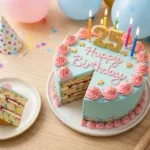
Happy birthday cake: 7 best tips for a perfect celebration
Want to bake a showstopper? This happy birthday cake recipe guarantees a moist, delicious crumb every time. Learn the secrets to professional results. Try.
Yield: 5 people
Equipment
- pringform or Standard Cake Pans: Ensure they are lined with parchment paper for effortless release. Digital Kitchen Scale: Accuracy is 30% more important than following a timer—measure your grams! Stand Mixer: Provides the consistent speed needed to cream butter and sugar properly. Offset Spatula: Your best friend for achieving professional-looking frosting levels.
Materials
Cake Flour: Its lower protein content produces a tender, velvet-like crumb that all-purpose flour simply cannot match.Unsalted Butter: Use high-quality, European-style butter (82% fat) for superior flavor and emulsion.Large Eggs: Room temperature is non-negotiable—they incorporate air far more effectively than cold eggs.Whole Milk or Buttermilk: The acidity in buttermilk reacts with baking soda to create a lighter lift.Pure Vanilla Extract: Invest in real vanilla; the artificial stuff just doesn't offer the same depth
Instructions
Step 1: Creaming the Base
Begin by creaming your butter and sugar on medium-high speed for at least 5 minutes. This creates tiny air pockets, which is the primary driver of a fluffy cake.Step 2: The Egg Integration
Add eggs one at a time, ensuring each is fully incorporated before adding the next. This emulsion prevents the batter from curdling and keeps the structure stable.Step 3: Mixing the Dry Ingredients
Sift your flour, baking powder, and salt. Gently alternate adding the dry ingredients and milk into your butter mixture. Stop mixing as soon as the last streak of flour disappears. Overmixing develops gluten, which leads to a tough cake.Step 4: The Bake
Pour into prepared pans and bake at 350°F (175°C). Use the "bounce-back" test: the cake is done when the center springs back lightly when pressed with a finger. For smaller gatherings, refer to small batch baking the cakes for two handbook.Step 5: Cooling and Frosting
Let the cakes cool in the pan for 10 minutes, then turn them onto a wire rack. Never frost a warm cake, or your icing will slide off! Explore mastering the art of traditional layer cakes to perfect your crumb coat technique.